
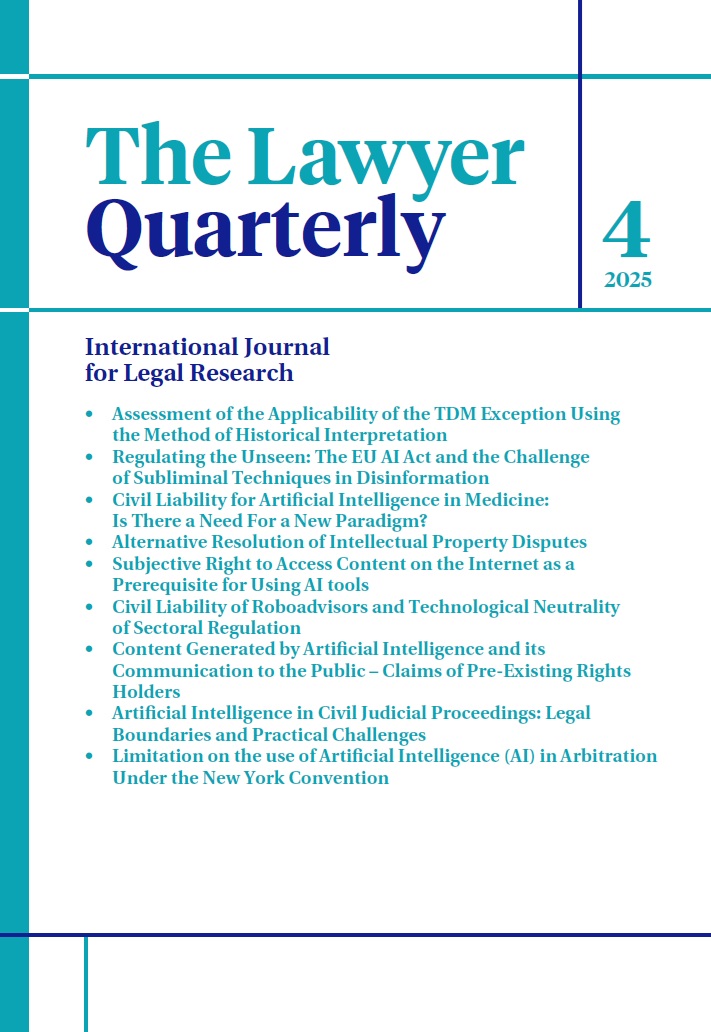
CONTENT GENERATED BY ARTIFICIAL INTELLIGENCE AND ITS COMMUNICATION TO THE PUBLIC – CLAIMS OF PRE-EXISTING RIGHTS HOLDERS
Article Sidebar
Main Article Content
Abstract
This article examines whether and to what extent the use of outputs generated by generative artificial intelligence (AI) infringes upon the rights of authors, performers, and producers of recordings. It builds on the premise that general AI models are trained using datasets that include indirect reproductions of protected subject matter. The paper questions the applicability of copyright exceptions, such as text and data mining (TDM) and temporal reproduction, for the training and use of these models. It differentiates between the liability of AI providers and users, arguing that public communication of AI-generated content may involve the unauthorized use of preexisting protected subject matter. Further, the article addresses issues of adaptation, inspiration, and potential infringement through plagiarism or imitation. It concludes by proposing legislative changes.
Article Details
Copyright and originality of the offered manuscript
1. It is assumed that the manuscript offered has not been previously published. It is expected that the authors will inform the editorial board of TLQ if the entire manuscript, its parts or some relevant results have been previously published in a different publication at the level of an article in a reviewed scientific magazine or monograph. Should the editorial board of TLQ conclude that this condition was not fulfilled the review process may be terminated.
2. It is assumed that the submitted manuscript is an original academic work. If that is not the case the author needs to provide information regarding all circumstances that could raise doubts whether the manuscript is the outcome of original research.
3. By submitting the manuscript the author acknowledges that after the publication in The Lawyer Quarterly her/his work will be made available online to the Internet users and also kept by the Library of the Academy of Sciences of the Czech Republic. Author's rights to further use the work remain unabridged.