
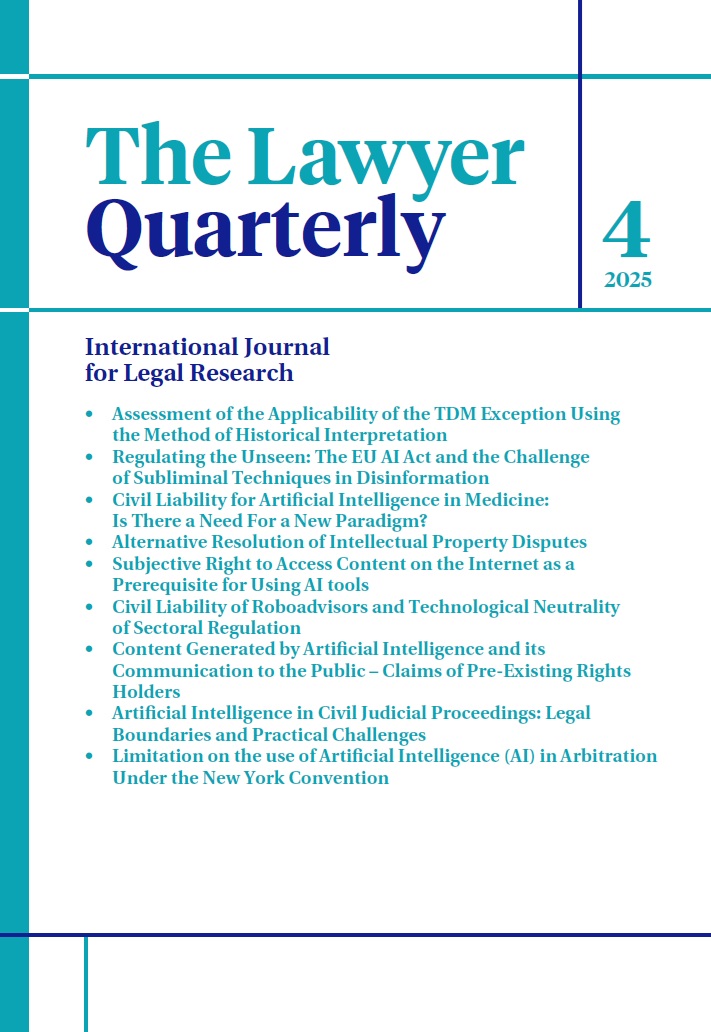
LIMITATION ON THE USE OF ARTIFICIAL INTELLIGENCE (AI) IN ARBITRATION UNDER THE NEW YORK CONVENTION
Article Sidebar
Main Article Content
Abstract
AI as a new technology clearly raises many questions across all public and private areas, arbitration being no exception. Although AI introduces numerous beneficial tools for arbitration such as document analysis or data collection, it also poses several risks. The most significant and most discussed risks include compromising due process, integrity of the proceedings, and confidentiality of arbitrators. Jeopardizing these fundamental values and principles of arbitration also entails a risk of making an arbitral award revocable, unrecognizable and unenforceable.
Since AI is a recent phenomenon, there is still no detailed regulatory framework or developed case law providing parties with rules on the use of AI in arbitration that would minimaze the risk of issuing unenforceable award. Some arbitral institutions seek to address this legal uncertainty and publish their guidelines regarding the use of AI in arbitration proceedings. However, without established arbitration practice, it is not yet clear whether these rules are sufficient to ensure due process, procedural integrity, and confidentiality of arbitrators when using AI. It is therefore necessary to look also at other sources of regulation that would provide a framework for the lawful use of AI in arbitration. One such source is the Convention on the Recognition and Enforcement of Foreign Arbitral Awards (New York Convention) and related case law. If parties want to have an arbitral award that is recognizable and enforceable even in countries outside the jurisdiction of the arbitral tribunal, they should not disregard the rules set forth in this New York Convention.
This article considers the limitation of the use of AI in arbitration from the perspective of the New York Convention. Specifically, it focuses on a violation of the right to be heard pursuant to Article V(1)(b) of the New York Convention and a violation of public policy pursuant to Article V(2)(b) of the New York Convention.
Article Details
Copyright and originality of the offered manuscript
1. It is assumed that the manuscript offered has not been previously published. It is expected that the authors will inform the editorial board of TLQ if the entire manuscript, its parts or some relevant results have been previously published in a different publication at the level of an article in a reviewed scientific magazine or monograph. Should the editorial board of TLQ conclude that this condition was not fulfilled the review process may be terminated.
2. It is assumed that the submitted manuscript is an original academic work. If that is not the case the author needs to provide information regarding all circumstances that could raise doubts whether the manuscript is the outcome of original research.
3. By submitting the manuscript the author acknowledges that after the publication in The Lawyer Quarterly her/his work will be made available online to the Internet users and also kept by the Library of the Academy of Sciences of the Czech Republic. Author's rights to further use the work remain unabridged.